
San Diego Collaborative Divorce Attorney
You’re getting divorced, and you want to do so with your dignity intact, your private life kept private, and without a courtroom battle. However, you still want the support of a legal representative. Wanting a peaceful resolution and legal protection is not a contradiction. At Bremer Whyte Brown & O’Meara, our experienced collaborative divorce attorneys provide in-depth legal expertise, guidance throughout the divorce process, and representation that prioritizes your interests while maintaining collaboration.


.2511070541334.png "Best Law firms | 2026")




What Is Collaborative Divorce in California?
Collaborative divorce in California is a process in which both spouses and their attorneys agree in writing to resolve every issue through negotiation with a team of professionals rather than in court. Both parties have a team with their own divorce attorney and other experts that apply to their unique situation, like financial specialists and child custody specialists. Both teams collaborate in joint meetings rather than prepare as opposing sides for trial. Parents often choose collaborative divorces to reduce the impact of the case on their children.
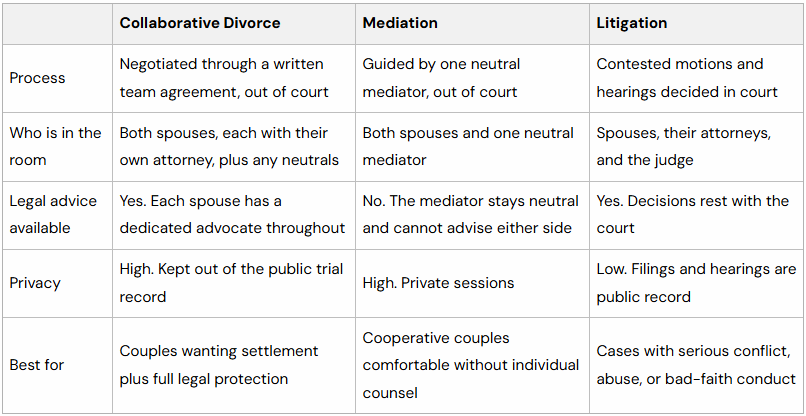
Collaborative Divorce vs. Mediation vs. Litigation
Many confuse the terms collaborative divorce, mediation, and litigation. Choosing the right one for you depends on how much legal advocacy each spouse wants during negotiation.
How the Collaborative Divorce Process Works, Step by Step
The collaborative divorce process follows a clear path designed to keep both spouses informed, protected, and effectively moving toward resolution. Collaboration depends on both parties being open to communicating and actively choosing to avoid conflict.
- Initial consultation to confirm that collaborative divorce suits the situation.
- Sign the participation agreement committing both spouses and their attorneys to the collaboration process.
- Assemble the team of additional neutral parties as needed.
- Exchange full financial disclosure.
- Hold a joint four-way meeting to negotiate asset division, support, and parenting terms.
- Finalize the written agreement and submit it in the pending dissolution case for the court’s final judgment.
What Happens If You Cannot Reach an Agreement?
If a collaborative divorce fails, there is a strict consequence. Both teams, including attorneys, are disqualified from representing either spouse in later litigation. Both spouses must retain new counsel. Keep in mind that communications from the collaborative process are typically treated as privileged and confidential, which means that anything said during negotiations cannot be used against either spouse later.
The confidentiality allows both parties to speak candidly, make compromises, and share sensitive information. Working together to reach a resolution generally makes divorce easier. The potential disqualification of the attorneys and carefully curated team keeps everyone invested in concluding the process peacefully. If you feel that resolution is impossible, we can try different approaches that may be more satisfactory based on individual circumstances.
Is Collaborative Divorce Right for You?
Collaborative divorce works best when both spouses can communicate in good faith and are willing to negotiate. Collaboration isn’t appropriate when there is domestic violence, a significant power imbalance, or if one spouse is unwilling to disclose their finances fully. During the initial consultation, we will discuss your situation to decide if it’s reasonable or safe to try collaboration. In some cases, we may advise against it if we believe that it won’t be successful or if we are worried about you being manipulated during negotiations.
Privacy and Discretion in Collaborative Divorce
Collaborative divorce keeps negotiations out of the public courtroom record, making it especially valuable for business owners, executives, high-net-worth individuals, and anyone who wants their financial and personal matters to stay private. The collaborative divorce process is designed to protect both parties so confidential information stays within the team. This privacy further encourages cooperation to avoid public court hearings.
Common Mistakes That Delay a Collaborative Divorce
Even collaborative divorces can stall when the fundamental components of the divorce process are handled carelessly. Most delays result from unavoidable errors. Being aware of potential pitfalls helps you prevent them as much as possible and navigate them if they do surface during the process. The most common mistakes include:
- Hiding assets. Concealed income, unlisted assets, and undervalued property can destroy the trust that is the foundation of collaborative divorce.
- Incomplete paperwork. Missing signatures, blank fields on digital forms, and unfinished disclosure forms result in documents being returned and meetings being postponed.
- Unfinished parenting plans. A parenting plan that leaves schedules, holidays, or decision-making authority unresolved can lead to conflict and prolonged negotiations.
- Ignoring local filing rules. Different San Diego courthouses have their own procedures for divorce, and overlooking them can delay your final judgment.
Our San Diego Collaborative Divorce Lawyers
At Bremer Whyte Brown & O’Meara, our highly skilled collaborative divorce lawyers provide hands-on support, negotiation expertise, a network of experts, and guidance through the challenging process of getting divorced.
-
 Nicole WhytePartner, Certified Family Law Specialist
 -
Nicole L. SchmidtPartner, Certified Family Law Specialist
-
Sheila C. StilesPartner, Certified Family Law Specialist
-
Jocelyn RussoPartner, Certified Family Law Specialist
-
Kendall E. YoungmanAssociate, Certified Family Law Specialist
-
Pamchal DeylamiPartner, Certified Family Law Specialist
-
Shannon K. MillerAssociate
-
Lauren SorsbyAssociate
-
Christina BatsakisAssociate, Certified Family Law Specialist
-
Kimberly A. DavisAssociate
-
Erin K. TomlinsonAssociate, Certified Family Law Specialist
-
Emily D. NevesAssociate












What Does an Uncontested Divorce Cost in San Diego?
Uncontested divorces typically cost less than contested divorces because there are fewer disputes and court appearances. When spouses can agree on the major terms, professional time spent on the case is reduced. The exact amount you will pay depends on your unique circumstances, so if you come across any websites claiming that they know the exact cost of a divorce, it usually isn’t realistic. The real drivers behind the cost are attorney fees and filing fees.
Why Choose Our San Diego Collaborative Divorce Attorneys?
Ending a marriage without a courtroom battle takes more than good intentions. It takes a team that knows the process, has the right neutral experts on call, and has the judgment to protect you at every step. That is what we bring to the table.
- Formal collaborative law training. Our attorneys are trained in the collaborative model, so they know how to protect your interests while keeping the process constructive.
- An established network of neutral specialists. We work with trusted financial specialists and child specialists, so your team can be assembled quickly with professionals who understand collaborative practice.
- Experience keeping high-profile matters private. We know how to structure a collaborative case so sensitive financial and personal details stay out of the public record.
- A smooth fallback if needed. If the collaborative process cannot resolve your case, we help you transition to litigation with new counsel arranged cleanly, so a breakdown does not leave you scrambling.
Serving All of San Diego County
We represent clients throughout San Diego County, from downtown San Diego and the coastal communities of La Jolla and Del Mar to Carmel Valley, Encinitas, Chula Vista, and La Mesa. Wherever you live in the region, our attorneys are familiar with local family law and the courts that will review and approve your collaborative divorce agreement.
From the San Diego Central courthouse and the Vista courthouse serving North County to the El Cajon courthouse to the east, and the Chula Vista courthouse in the South Bay. Our local knowledge helps your case clear the court’s requirements smoothly once you and your spouse have reached agreement. We help you avoid delays and adhere to all legal requirements from day one.
Call Now to Consult an Uncontested Divorce Lawyer Serving San Diego, CA
You can end your marriage respectfully, keep your private details confidential, and still have expert legal protection every step of the way. Starting with a consultation costs you nothing and helps confirm whether the collaborative process actually suits your situation before you commit to anything. As collaborative divorce lawyers in San Diego, we will give you an honest answer and possible alternatives if you need them. Contact Bremer Whyte Brown & O’Meara to schedule your confidential consultation, or reach out through our contact form.
Frequently Asked Questions
Is collaborative divorce more expensive than mediation?
It can be, because each spouse has their own attorney rather than sharing a single neutral mediator. In exchange, you get dedicated legal advice and advocacy that mediation does not provide. For many couples, that added protection is well worth the difference, particularly when finances or parenting terms are complex.
Can collaborative divorce work if we have children?
Yes, and it is often especially well suited to families with children. A neutral child specialist can join the team to help design a parenting plan focused on the children’s needs, and the cooperative, non-adversarial structure tends to preserve a healthier co-parenting relationship after the divorce.
What is a participation agreement?
It is the written contract, signed by both spouses and their attorneys, that formally starts the collaborative process. It commits everyone to negotiate in good faith, disclose finances fully, and resolve the case out of court. It also contains the disqualification provision requiring new attorneys if the process fails.
Do we still need to go to court at all?
In most collaborative divorces, neither spouse appears at a contested hearing. Once you reach a written agreement, it is submitted to the court for a judge’s approval and signature, which is a paperwork step rather than a courtroom battle. That final judgment is what legally ends the marriage.
How long does collaborative divorce take?
Timing varies with the complexity of your assets and parenting issues and how readily the two of you reach agreement. California’s mandatory six-month waiting period still applies before any divorce is final. Many collaborative cases resolve the substantive terms well within that window, then wait out the period.
Is collaborative divorce right for high-conflict couples?
Usually not. The process depends on both spouses negotiating in good faith and disclosing finances honestly, which is difficult in high-conflict situations or where there is abuse or a serious power imbalance. In those cases, litigation or another approach often protects a vulnerable spouse better, and we will tell you so directly.

Client-Approved