
San Diego Property Division Lawyer
You’ve worked hard for everything you own: your home, business, retirement savings, and valuable assets. Now you’re getting divorced, and it’s all at stake. Knowing how property division works under California law will help you prepare for what’s to come. The decisions you make now can affect your financial future for decades.
At Bremer Whyte Brown & O’Meara, our San Diego property division attorneys have years of experience handling divorces and property division in courts across San Diego County. Whether your divorce is straightforward and easily resolved or you’re facing complex property division matters, our team is here to guide you through the process.
California is a community property state, which means that all debts and assets acquired during the marriage must be split equally between the spouses if they get divorced. Our job is to help you identify what counts as community property, which assets are separate, value your property accurately, and protect your fair share of the marital estate. Call us to discusswhat happens next and start developing a strategy.
What Is Community Property in California?
Community property is all property and debt that spouses acquire during the marriage that is not separate property. In general, community property is divided equally between spouses regardless of who earned or purchased it. The equal division rule is the foundation of California property division for divorcing couples.
Separate property is any assets or debts acquired before the marriage, after the date of separation, or received by one spouse alone as a gift or inheritance. Separate property stays with the spouse who earned or purchased it. During the divorce process, separate property can become disputed if it’s not clearly documented or is mixed with community funds.
What Counts as Property to Be Divided?
Property division covers far more than the family home. In a divorce in San Diego, nearly everything of value that the couple acquired during the marriage may be part of the marital estate. Common categories include:
- The family residence and any other real estate.
- Bank accounts and investment accounts.
- Retirement accounts and pensions.
- Business interests owned by either spouse.
- Stock options and other deferred compensation.
- Personal property such as vehicles, furniture, and collectibles.
- Debts acquired during the marriage.
Remember that debts are divided along with assets. Under California law, community debt is treated the same way as community property, so loans, credit card debt, and other obligations taken on during the marriage are divided equally between the spouses.
When Separate and Community Property Become Mixed
In many long-term marriages, separate property and community property are gradually combined so thoroughly that it’s difficult to tell them apart. This process is called commingling. When marriages with commingled property end, a court must trace the source of funds to determine each spouse’s exact share. In California, courts use established formulas to untangle these situations.
When community funds pay down a mortgage on a separate property home, the Moore Marsden formula is used to account for the property’s increased value during the marriage. The Pereira and Van Camp methods apply when a separate property business grew in value because of a spouse’s work during the marriage. An experienced attorney and a forensic accountant are often needed to apply these methods correctly.
How Community Property Is Valued
Most property division disputes aren’t really about who owns what; they are usually about the value of the property. Spouses may agree that a house is community property, but completely disagree over its value. These disagreements are where the real fight often happens. The table below shows how different assets are typically valued and when an expert is needed.
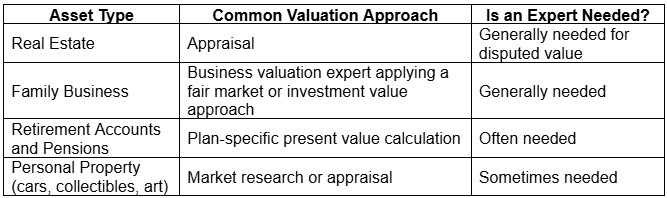
If the spouses cannot agree on value, the court can appoint its own neutral expert to evaluate an asset. Either spouse may also present their own expert testimony to support their position, which is common in cases involving a business or high-value asset.
Dividing Businesses, Retirement Accounts, and Other Complex Assets
A business started or expanded during the marriage is generally treated as community property to the extent that its value increased during the marriage, even if only one spouse operated it. Determining that value can be complicated and usually requires reviewing financial records. In contested cases, you may need a business valuation expert to determine the true worth of the business.
Retirement accounts and pensions are commonly divided using a Qualified Domestic Relations Order (QDRO). A QDRO is a court order that tells the retirement plan administrator exactly how to split the account between the spouses. Dividing these assets through a properly drafted QDRO is what avoids unnecessary tax penalties and delays, so precision is crucial.
Property in another state raises a concept called quasi-community property. This is property acquired while the couple lived outside California that would have been community property if acquired here. California treats quasi-community property much like community property in a divorce. This issue often affects military families because they live in so many different states.
Factors That Can Affect How Property Is Divided
Community property is generally split equally, but certain conduct or circumstances can affect the overall financial outcome of a case. The factors that most often affect property division can include:
- The length of the marriage.
- Each spouse’s financial and non-financial contributions.
- The economic circumstances of each spouse at the time of divorce.
- Whether one spouse dissipated or misused community assets, such as hiding money or making unauthorized gifts of community funds.
Misuse of community assets can result in a court awarding a smaller share to the spouse responsible. However, this outcome depends on the facts, which an attorney must evaluate before making any final decisions.
Where to File: Jurisdiction in a Property Division Case
To divide a couple’s property appropriately, a California court needs authority over the divorce. Either spouse must have lived in California for six months and in San Diego County for at least three months before the divorce can be processed here. Property located in another state, a business incorporated elsewhere, or a couple who recently relocated to or from San Diego can raise questions about which court has authority over which assets, especially with quasi-community property.
Timing matters too. The date of separation affects what counts as community property, because income and assets acquired after that date are generally separate property. This often comes up for spouses who own real estate in more than one state, run a business with operations outside California, or are military families that relocate frequently. Confirm jurisdiction and the date of separation with an attorney early, as both affect how property is ultimately divided.
Our San Diego Divorce Mediation Attorneys
Our family law team has experience handling straightforward and complex property division matters across San Diego County, including disputes over businesses, retirement accounts, and commingled assets. Our range of experience means we can help you whether your case is a clean split of clearly separate assets or a hard-fought dispute requiring experts.

-
 Nicole WhytePartner, Certified Family Law Specialist
 -
Nicole L. SchmidtPartner, Certified Family Law Specialist
-
Sheila C. StilesPartner, Certified Family Law Specialist
-
Jocelyn RussoPartner, Certified Family Law Specialist
-
Kendall E. YoungmanAssociate, Certified Family Law Specialist
-
Pamchal DeylamiPartner, Certified Family Law Specialist
-
Shannon K. MillerAssociate
-
Lauren SorsbyAssociate
-
Christina BatsakisAssociate, Certified Family Law Specialist
-
Kimberly A. DavisAssociate
-
Erin K. TomlinsonAssociate, Certified Family Law Specialist
-
Emily D. NevesAssociate












Why Choose Our San Diego Property Division Attorneys
Property division is where a divorce is won or lost financially. The difference between a fair result and a costly one often comes down to accurate valuation and the right experts. Here is what sets us apart.
- We work with forensic accountants and valuation experts. We know how to build a case with the right professionals, so we handle hidden income, disputed business value, and commingled funds with credible evidence.
- We explain complex concepts in plain English. Tracing, quasi-community property, and QDROs can be confusing. We make sure you understand what is happening and why, so you can make informed decisions.
- We know San Diego Superior Court. We know how the local court handles property division matters, which helps your case move forward efficiently.
- We handle out-of-state and military property questions. Multi-state assets and quasi-community property are common for relocating and military families, and we have experience sorting out who gets what across state lines.
Serving All of San Diego County
We help clients throughout San Diego County, and our Family Law Attorneys in San Diegoserve clients from downtown San Diego and La Jolla to Carlsbad and Chula Vista, as well as Del Mar and Encinitas along the coast. Wherever you live in the region, our attorneys are familiar with the local family courts that will hear and decide your property division case. These include the San Diego Central courthouse, the Vista courthouse serving North County, the El Cajon courthouse to the east, and the Chula Vista courthouse in the South Bay.
Call Now to Consult a Property Division Lawyer Serving San Diego, CA
From the family home to complex business and retirement assets, your fair share of the marital estate should be protected. Bremer Whyte Brown & O’Meara help you identify community vs. separate property, value it accurately, and fight for the outcome you’re entitled to under California law. A consultation costs you nothing and helps clarify exactly what’s at stake in your case. Contact our teamto schedule your confidential consultation with an expert property division lawyer in San Diego.
Frequently Asked Questions
How are debts divided in a California divorce?
Debts are generally divided the same way as assets. Community debt, meaning debt taken on during the marriage, is typically split between the spouses. In contrast, separate debt stays with the spouse who incurred it. As with property, correctly characterizing each debt as community or separate is key, and disputes often center on when and why the debt was incurred.
Do I need a business valuation expert for my divorce?
If a business is part of the marital estate and its value is disputed, a valuation expert is usually necessary. Business value rarely appears clearly on tax returns, so an expert reviews the finances to determine fair value. In simpler cases where both spouses agree on value, you may not need one, but an attorney can help you decide.
What is a Qualified Domestic Relations Order?
A Qualified Domestic Relations Order, or QDRO, is a court order that directs a retirement plan administrator on how to divide a retirement account between divorcing spouses. It allows the account to be split without triggering early-withdrawal penalties or unexpected taxes. Drafting it correctly is essential, as errors can cause costly delays or tax consequences.
Can my spouse hide assets during property division?
It happens, but California law strongly discourages it. Both spouses must fully and honestly disclose all assets and debts. A spouse who hides assets can face serious penalties, including losing their share of the concealed asset. Forensic accountants, subpoenas, and formal discovery are the tools used to uncover hidden money and bring it back into the division.
Client-Approved